> ## Documentation Index
> Fetch the complete documentation index at: https://docs.fryte.com/llms.txt
> Use this file to discover all available pages before exploring further.
# Search Corridor
> How the corridor width changes which stations the optimizer can choose from.
The `corridor` query parameter (1000–20000 meters, default `8000`) controls how far off the
route the optimizer looks for charging stations. Every station within that distance is a
candidate; everything outside is invisible to the optimizer. A wider corridor means more
candidates — often better chargers — at the cost of potentially longer detours and, for very
wide corridors, driving-time estimates that are harder to guarantee.
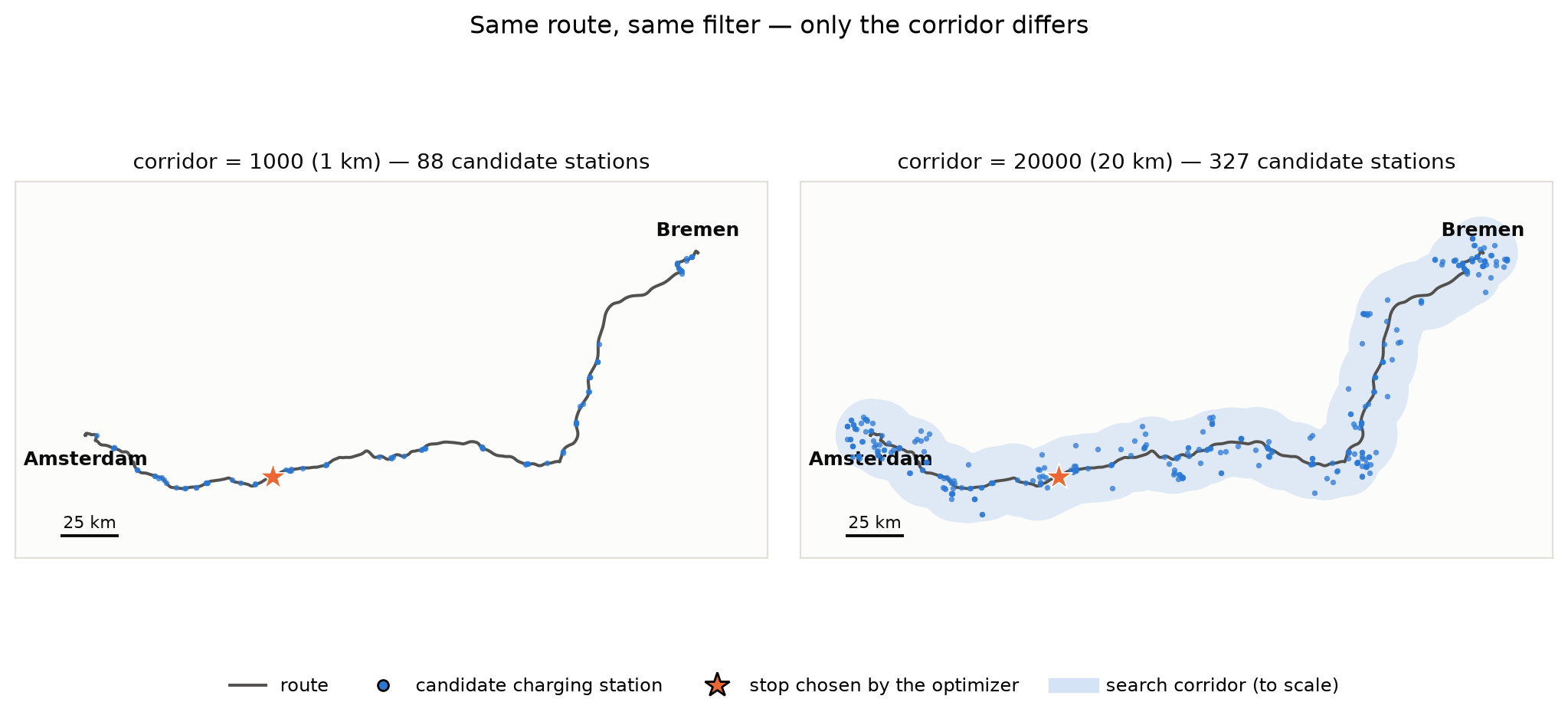
The same Amsterdam → Bremen request with `corridor=1000` and `corridor=20000`:
 ## Request
```bash curl theme={null}
curl -X POST "https://api.fryte.com/planner/v2?corridor=20000" \
-H "Authorization: Bearer " \
-H "Content-Type: application/json" \
-d '{
"vehicle_id": "010160700001",
"battery_level_start": 0.7,
"section_list": [
{
"start_pos": [52.3700, 4.9000],
"stop_pos": [53.0800, 8.8100],
"payload_kg": 19300
}
],
"poi_info": {
"min_kW": 150,
"connector_type": ["CCS"],
"truck_approved": "TT"
}
}'
```
```python Python theme={null}
import requests
response = requests.post(
"https://api.fryte.com/planner/v2",
params={"corridor": 20000},
headers={"Authorization": "Bearer "},
json={
"vehicle_id": "010160700001",
"battery_level_start": 0.7,
"section_list": [
{
"start_pos": [52.3700, 4.9000],
"stop_pos": [53.0800, 8.8100],
"payload_kg": 19300,
}
],
"poi_info": {
"min_kW": 150,
"connector_type": ["CCS"],
"truck_approved": "TT",
},
},
)
print(response.json())
```
```javascript JavaScript theme={null}
const response = await fetch("https://api.fryte.com/planner/v2?corridor=20000", {
method: "POST",
headers: {
"Authorization": "Bearer ",
"Content-Type": "application/json",
},
body: JSON.stringify({
vehicle_id: "010160700001",
battery_level_start: 0.7,
section_list: [
{
start_pos: [52.3700, 4.9000],
stop_pos: [53.0800, 8.8100],
payload_kg: 19300,
},
],
poi_info: {
min_kW: 150,
connector_type: ["CCS"],
truck_approved: "TT",
},
}),
});
const data = await response.json();
console.log(data);
```
```csharp C# theme={null}
using var client = new HttpClient();
client.DefaultRequestHeaders.Add("Authorization", "Bearer ");
var json = """
{
"vehicle_id": "010160700001",
"battery_level_start": 0.7,
"section_list": [
{
"start_pos": [52.3700, 4.9000],
"stop_pos": [53.0800, 8.8100],
"payload_kg": 19300
}
],
"poi_info": {
"min_kW": 150,
"connector_type": ["CCS"],
"truck_approved": "TT"
}
}
""";
var response = await client.PostAsync(
"https://api.fryte.com/planner/v2?corridor=20000",
new StringContent(json, System.Text.Encoding.UTF8, "application/json")
);
var result = await response.Content.ReadAsStringAsync();
Console.WriteLine(result);
```
## What changed between 1 km and 20 km
In the comparison runs behind the figure, both plans stop once — during the driver's mandatory
45-minute rest — and both arrive in Bremen at practically the same time. The difference is what
that stop is worth:
| | `corridor=1000` | `corridor=20000` |
| ----------------------------------- | --------------------------- | ---------------- |
| Candidate stations | 88 | 327 |
| Chosen stop | Tango electric, Rijksweg A1 | Fastned, De paal |
| Energy recharged in the 45-min rest | 40.5 kWh | **90 kWh** |
| Battery at destination | 31% | **40%** |
| Arrival time | 12:45 | 12:45 |
The wider corridor did not make the tour faster here — it made the *same rest stop* recharge
twice the energy, so the truck arrives with 9 percentage points more battery for the next leg.
Responses to requests with a non-default corridor include a warning: with a very wide corridor,
detours to far-away stations make the driving-time calculation harder to guarantee. Treat
`8000` as the sensible default and widen it when station coverage on the route is thin.
## Always set the truck-ready filter
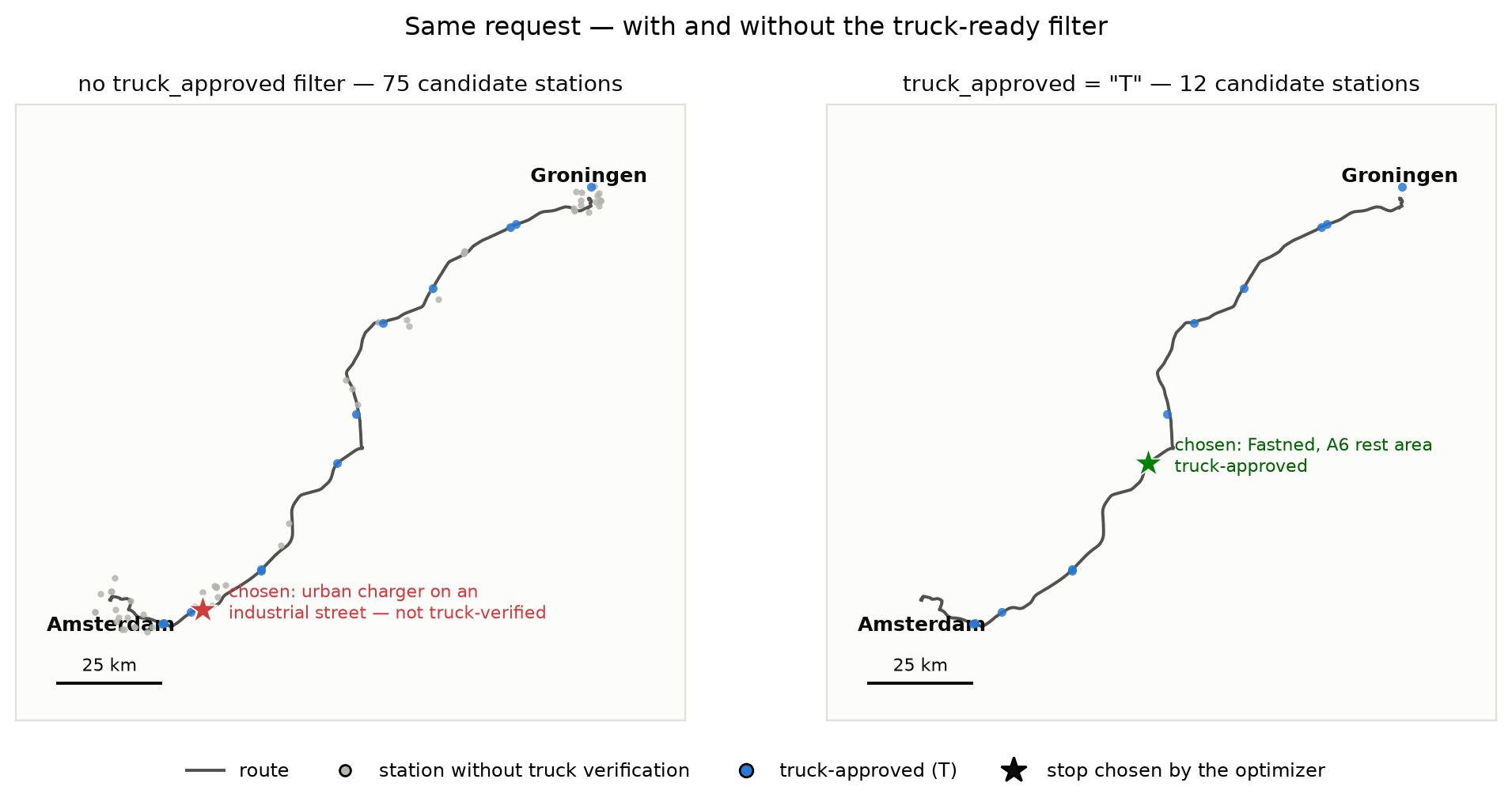
A wider corridor surfaces more stations — including urban chargers a 40-ton truck cannot
physically use (access, turning radius, parking bay length). The optimizer only checks power and
connector unless you tell it otherwise: **set `poi_info.truck_approved` as the starting point of
every truck request.**
* `"T"` — verified accessible for a tractor unit
* `"TT"` — verified accessible for a truck with trailer (subset of `T`)
The same Amsterdam → Groningen request with and without the filter:
## Request
```bash curl theme={null}
curl -X POST "https://api.fryte.com/planner/v2?corridor=20000" \
-H "Authorization: Bearer " \
-H "Content-Type: application/json" \
-d '{
"vehicle_id": "010160700001",
"battery_level_start": 0.7,
"section_list": [
{
"start_pos": [52.3700, 4.9000],
"stop_pos": [53.0800, 8.8100],
"payload_kg": 19300
}
],
"poi_info": {
"min_kW": 150,
"connector_type": ["CCS"],
"truck_approved": "TT"
}
}'
```
```python Python theme={null}
import requests
response = requests.post(
"https://api.fryte.com/planner/v2",
params={"corridor": 20000},
headers={"Authorization": "Bearer "},
json={
"vehicle_id": "010160700001",
"battery_level_start": 0.7,
"section_list": [
{
"start_pos": [52.3700, 4.9000],
"stop_pos": [53.0800, 8.8100],
"payload_kg": 19300,
}
],
"poi_info": {
"min_kW": 150,
"connector_type": ["CCS"],
"truck_approved": "TT",
},
},
)
print(response.json())
```
```javascript JavaScript theme={null}
const response = await fetch("https://api.fryte.com/planner/v2?corridor=20000", {
method: "POST",
headers: {
"Authorization": "Bearer ",
"Content-Type": "application/json",
},
body: JSON.stringify({
vehicle_id: "010160700001",
battery_level_start: 0.7,
section_list: [
{
start_pos: [52.3700, 4.9000],
stop_pos: [53.0800, 8.8100],
payload_kg: 19300,
},
],
poi_info: {
min_kW: 150,
connector_type: ["CCS"],
truck_approved: "TT",
},
}),
});
const data = await response.json();
console.log(data);
```
```csharp C# theme={null}
using var client = new HttpClient();
client.DefaultRequestHeaders.Add("Authorization", "Bearer ");
var json = """
{
"vehicle_id": "010160700001",
"battery_level_start": 0.7,
"section_list": [
{
"start_pos": [52.3700, 4.9000],
"stop_pos": [53.0800, 8.8100],
"payload_kg": 19300
}
],
"poi_info": {
"min_kW": 150,
"connector_type": ["CCS"],
"truck_approved": "TT"
}
}
""";
var response = await client.PostAsync(
"https://api.fryte.com/planner/v2?corridor=20000",
new StringContent(json, System.Text.Encoding.UTF8, "application/json")
);
var result = await response.Content.ReadAsStringAsync();
Console.WriteLine(result);
```
## What changed between 1 km and 20 km
In the comparison runs behind the figure, both plans stop once — during the driver's mandatory
45-minute rest — and both arrive in Bremen at practically the same time. The difference is what
that stop is worth:
| | `corridor=1000` | `corridor=20000` |
| ----------------------------------- | --------------------------- | ---------------- |
| Candidate stations | 88 | 327 |
| Chosen stop | Tango electric, Rijksweg A1 | Fastned, De paal |
| Energy recharged in the 45-min rest | 40.5 kWh | **90 kWh** |
| Battery at destination | 31% | **40%** |
| Arrival time | 12:45 | 12:45 |
The wider corridor did not make the tour faster here — it made the *same rest stop* recharge
twice the energy, so the truck arrives with 9 percentage points more battery for the next leg.
Responses to requests with a non-default corridor include a warning: with a very wide corridor,
detours to far-away stations make the driving-time calculation harder to guarantee. Treat
`8000` as the sensible default and widen it when station coverage on the route is thin.
## Always set the truck-ready filter
A wider corridor surfaces more stations — including urban chargers a 40-ton truck cannot
physically use (access, turning radius, parking bay length). The optimizer only checks power and
connector unless you tell it otherwise: **set `poi_info.truck_approved` as the starting point of
every truck request.**
* `"T"` — verified accessible for a tractor unit
* `"TT"` — verified accessible for a truck with trailer (subset of `T`)
The same Amsterdam → Groningen request with and without the filter:
 ```json theme={null}
"poi_info": {
"min_kW": 150,
"connector_type": ["CCS"],
"truck_approved": "T"
}
```
Without `truck_approved`, plans can route trucks to stations that are not truck-accessible —
this has happened in production with inner-city chargers around Amsterdam. If setting the filter
returns `not_drivable` or very few candidates, the region may lack verified truck stations:
widen the corridor, try `"T"` instead of `"TT"`, or contact FRYTE about coverage — do not drop
the filter for a truck.
```json theme={null}
"poi_info": {
"min_kW": 150,
"connector_type": ["CCS"],
"truck_approved": "T"
}
```
Without `truck_approved`, plans can route trucks to stations that are not truck-accessible —
this has happened in production with inner-city chargers around Amsterdam. If setting the filter
returns `not_drivable` or very few candidates, the region may lack verified truck stations:
widen the corridor, try `"T"` instead of `"TT"`, or contact FRYTE about coverage — do not drop
the filter for a truck.